In this article
MTF stands for Margin Trading Facility. It lets you buy eligible shares for delivery by paying only a part of the price — called the margin — while the broker funds the rest. In return, the broker charges interest on the amount it funds, every day you hold the position.
How MTF works
- You choose a share from the broker's approved MTF list.
- You pay your part (the margin). The broker pays the balance to the exchange.
- The shares are pledged in favour of the broker until you pay back the funded amount.
- You can hold the position for as long as you like, but interest keeps running every calendar day.
- When you sell, the funded amount and the interest are settled first; what remains is yours.
Unlike intraday leverage, an MTF position does not have to be closed the same day.
An example with numbers
The rates below are only illustrations. Every broker has its own rate card, so check yours.
- You buy 100 shares at ₹3,200 = ₹3,20,000
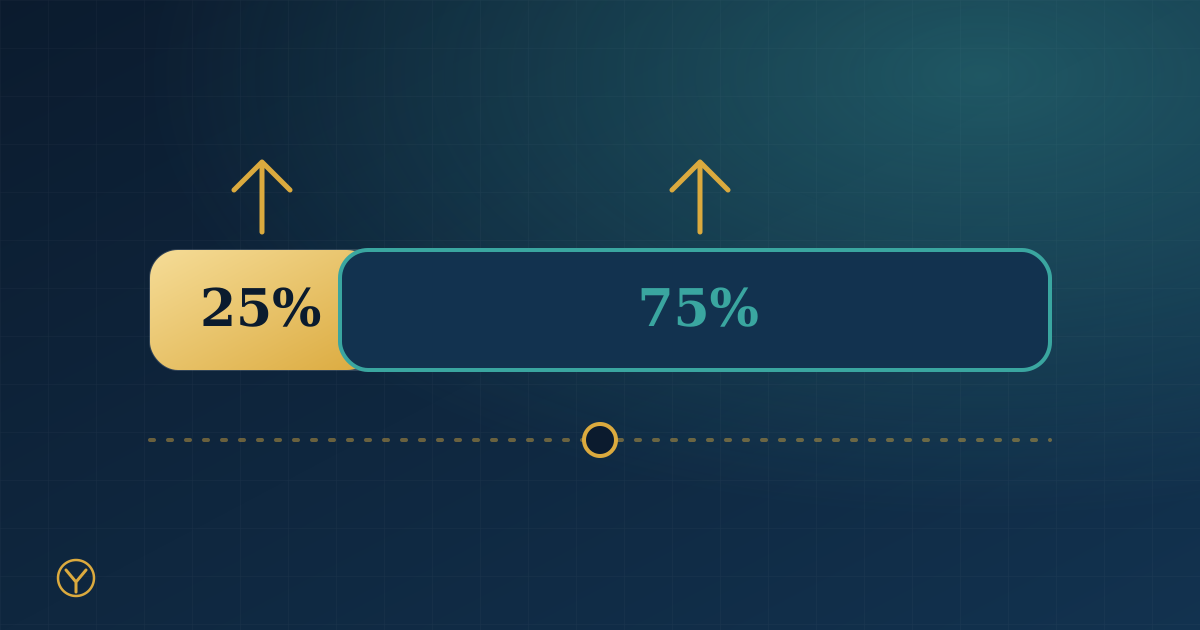
- Broker funds 75% = ₹2,40,000; you pay ₹80,000
- Illustrative interest: 21% a year on the funded amount
| Days held | Interest on ₹2,40,000 |
|---|---|
| 1 day | about ₹138 |
| 5 days | about ₹690 |
| 30 days | about ₹4,142 |
For 30 days, interest alone is about ₹41 per share — roughly 1.3% of the buy price. Add brokerage, STT, stamp duty, exchange fees, DP charges and GST, and you can see why the price has to rise noticeably before you even break even.
The break-even price
The break-even price is the lowest selling price at which your net result, after all charges and interest, is not negative. The longer you hold, the higher it moves. So before an MTF trade, ask: “Is my expected move bigger than the cost of holding?”
Risks to understand
- Leverage magnifies losses. If the price falls 10%, the loss is about ₹32,000 on the position — that is 40% of your own ₹80,000, before interest.
- Interest runs even when the trade is losing. A position that goes nowhere still costs you every day.
- Margin shortfall. If the price falls a lot, the broker can ask for more money or sell the shares to recover its funding.
- Limited list. Only approved shares are eligible, and the list and funding % can change.
Sensible habits
- Use MTF only for trades where you have a plan, a stop-loss and a time limit.
- Calculate the break-even price before you buy, not after.
- Keep spare money for a fall — do not use the last rupee you have as margin.
- Do not treat cheap-looking leverage as free money. The interest is a certain cost; the profit is only a hope.